
Defending Overloads in the Final Third
Part 2: Progression 10 Ball
By: Matt Carroll
This session is the third in my team’s summer session folder. In New Jersey, we have an open period where any team can hold sessions. With multisport athletes, summer tournaments, and our participation in a summer league, we try to keep it to one session a week. We have to plan to not have all of our squad, and a fairly mixed group of freshmen, JV, and varsity-level players. Taking this into account, we tend to try things out and introduce topics that, once the season starts, we can revisit and refine. This session, we are working on overloads, but specifically in the final third, so players are really focused on creating the lowest percentage shot possible, covering their angles, and making sure to delay the attack long enough for players to get back and help on defense.
The next drill in this session we’ll move to is the 10 Ball Progression. This is a drill I have talked about in several other sessions, and it's something Ive used for both my youth and high school age teams. In both cases, players liked the competitive nature and the pressure coming from the limited number of attacks.
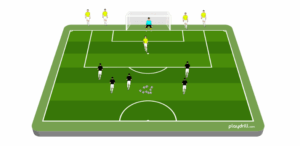
To set up this drill, the attackers are positioned inside the 18 with a goalie. For this progression, defenders start with 1 defender in the box and 4 others behind the goal, and a goalie. The attackers start outside the box beyond the arc and have 5 players and 10 balls set up in a pile. The game starts when the ball enters the 18 with a 5v1 with a goalkeeper. The ball can be passed or dribbled in, but once the ball enters the 18, the defenders can attempt to win the ball. Play then stops when there is a goal or the ball leaves the 18 from a shot or a clear. The attackers then must retrieve a new ball, and the game restarts when the next ball enters. The drill ends when all 10 balls have been spent, and then it can reset, or teams can switch sides.
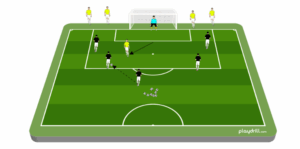
For this progression, we start with one defender and add an additional defender every two balls, so once the attacking team goes to collect their third ball, the drill turns to a 5v2+GK. We want to be heavy on the coaching here in terms of angles, what are low % shots, when to press, and when to drop. The attacking team having to leave the grid to retrieve the ball creates a natural stoppage for this coach. The rest of the session will be more fluid, so we really want to focus on getting the key coaching points across at this point. The idea here isn’t necessarily to stop the opposition from scoring early on, since the defenders are so overwhelmed numerically, but we do want the players on and off the field to recognize where a player could have been in a certain situation that would have been able to cut off a scoring opportunity, that way when the we go from a 5v1 to a 5v2 to 5v3 and beyond players can take what they recognized watching the game and apply to live scenarios as we scale up to a even 5v5.
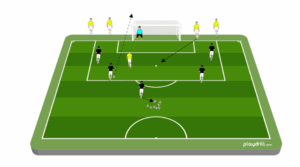
From here we’ll move to a conceptually similar drill, but more fluid in a drill called Timed Release.

