
Defensive Reaction Drill
By: Matt Carroll
One thing my team is working on currently is an issue with dealing with quick resets and long throws. At this stage of the season we are in the midst of 2-3 games a week and coming off a Monday night game-session- 345pm kickoff game before a long break. We then have a week off so we can work on recovery on Thursday and give a weekend off to the players, but between that we have to make an adjustment from a team that looks to dominate possession to playing against a team that is traditionally reliant on set pieces and long throws to make other teams uncomfortable. The session I am introducing this intro is a quick recovery, since our practice slot is less than 24 hours after our last match, so we are planning on going film session, recovery stretching, pattern play, and then moving onto this defensive reaction drill to work on a mid-intensity drill with a focus on concentration.
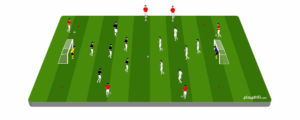
The drill starts with a goal at either end, one at the end line and the other halfway between the 18 and half, with the sidelines cut about 10 yards in from the touch line and three teams of 6 with a keeper in each goal. The team that is off is setting themselves up in positions around the field to either play in long throws or quickly play in passes from the end line.
Play begins with a normal 6v6, with each team attempting to score. If a play goes out to touch, the team on the outside selects a thrower and gets to play in a long throw towards goal for the team that won possession. Once the ball is in play, the game continues as normal. If the ball goes out the touchline, whether the attacking team played it out or not, one of the 3rd team players positioned halfway between the corner and the goal will play a low driven ball into the 18 to the attacking team as a second chance. There should be little hesitation between the ball going out and the second ball being put into play to ensure that players are forced to address the visual cue of the ball going out and not having time to turn off one’s focus. After either a goal or a set time limit, the team that was on the outside then enters play, replacing one of the on-field teams.
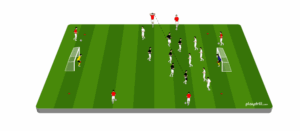
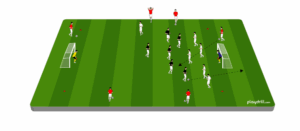
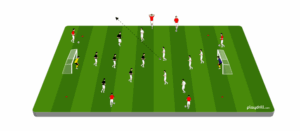
The focus here is that the ball out of play does not mean danger is over; players have to work to lose that concept of the ball going out meaning they will get a short break while the ball is retrieved. The long throw and low driven pass options can both be changed to whatever danger your team is likely seeing in your match, but the key focus is the rapidity with which the next ball in is played. For our session in terms of our periodization, we want these to be short, but intense moments, which long breaks for the players on the outside, but even though there is a drop in the physicality on the outside, the necessity of their focus is still there the whole time.

