
Midfield Rotation Pattern
By: Matt Carroll
This midfield rotation pattern is designed to work on the movement of the center midfielders positionally and then technically for them to play a layoff pass to an overlapping player in order to break lines. The movement of the midfielders requires timing and communication, and the intensity of the drill created by this timing makes it essential for teams looking to break any type of pressure against your central midfielders.
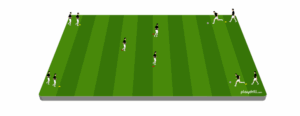
The drill starts with three central midfielders in the center of the drill and four cones, creating a rectangle around the central three, about 5 yards wide and about 15 yards long, away from the center on each side. There should be a line of players at each corner of the rectangle.
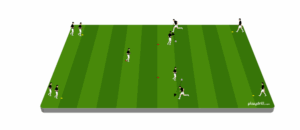
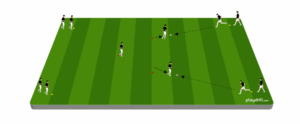
The drill starts with both players on the cone on one side of the rectangle passing to the central player closest to them. They then run to the outside shoulder of that player, and the central player then plays a layoff pass to the original passer. That player receives and plays a pass to the far side line. When they receive, they pass back to the original passer, who then lays off a pass to the player from the second line. They then dribble their way to the first line and pass to the next player in the first line without a ball. After each pass is played, the central midfielders rotate either clockwise or counterclockwise.
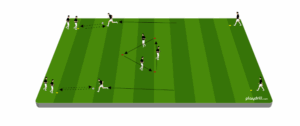
The key points for the central midfielders are that they are simulating running with a defender on their back and checking towards the ball. We want these movements to be at game speed since we are trying to simulate breaking a line with an overlap, and we want the movement of the midfielder to drag the defender with them, which won’t happen if they are standing still when they receive. We also want to focus on the movement of the midfielders. We do not want them to be standing still, but we also want the runs timed so there is only one midfielder at each cone at a time. Scanning and communication are key here to make sure the rotations are crisp and clean.
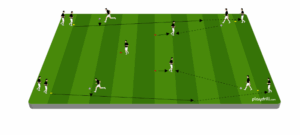
For the other lines, we also want to time our runs so we are not running past the midfielder and then having to wait for the pass to be played; the run should be timed up so the hypothetical defender would still be moving towards the midfielder, and the pass and subsequent dribble create distance between the attacking player and the defender. The next pass should do the same, and timing and technical ability are key.
Overall, the tempo, communication, and technical requirements for this drill make it a solid choice for a technical activation for a possession or line-breaking session, or a strong pre-game warm-up to get players activated and ready for match conditions.

