
Session: Pressure Cover Balance Part 3: Three Keeper Box Game
As always, making it to the United Soccer Coaches Convention was an enlightening experience. So many brilliant minds and concepts all pulled together at the same time, it's hard not to get excited to get back onto the field. In particular, I was inspired by the presentation by Coach Shap (who we had on the podcast in episode 408), where he discussed periodization and season long planning. The NJ High School season is still well away, but I am already trying to get some concept of what areas I want to focus on during our first weeks of the season. The session I am going to talk about here would likely be our fourth session of pre-season. The first two days being tryouts, then the 3rd, 4th, and sometimes 5th being days where the JV and Freshman squads are doing mirror sessions with the varsity. Conceptually, what I am trying to do is lay down basic tenets of our methodology to the players, as well as structuring the session to give my coaches a concept of the expectations and verbiage that we want to utilzie when talking about our core principles. Generally, what I want to do is hit major themes, scanning, pressure/cover/balance, and our shape in the middle third, and our key attacking concepts in the final third. This session will cover our defensive core concepts, focusing on basic 1v1 defending and building to the full pressure/cover/balance structure.
How do you structure your pre-season. Do you do something similar, do you make the focus specific game moments, do you break down sessions based on position? Let me know by reaching out to Matt@pennantcoaching.com.
The drill starts with a field making up the top of the 18 to the halfway line. With three 10x10 boxes arranged around the grid. In each grid is a goalkeeper. There is two teams spread around the grid and two balls that are played in by the coach. Field players are not allowed to enter any of the boxes, and the goalkeepers cannot leave their boxes. Players score by connecting a pass that breaks two lines of the box and is retrieved on the other side by one of their teammates. If the pass is intercepted by the goalkeeper, they then punt the ball randomly somewhere else in the grid. At the end of the allotted time, the team that has completed the most passes through the box wins the game.
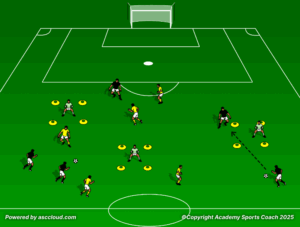
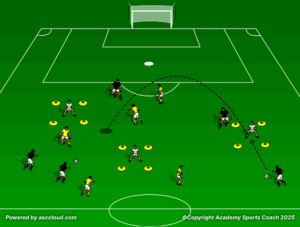
The coaching points for this drill is to find the numerical advantages on offense and get compact defensively. If there are few defenders around the box the attacking team can score multiple points in a short span, but if they try to force the ball through when they are numbers down they can easily turn the ball over. The defense, because the grids are so small, can effectively drop in front of the boxes and get compact, making it difficult for the opposition to find a way through.
The size of the grid, the size of the box, and the shapes of the goalie boxes can all change to vary the difficulty of the drill.
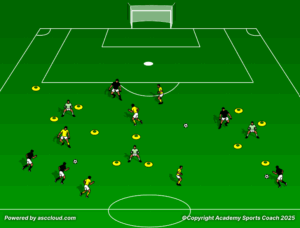
When I ran this drill the first time, something that stood out was one of the players involved was walking around aimlessly. When I asked him what he was doing he explained that he had no idea, and that too much was going on. He was overwhelmed by the amount of stimuli and decision making that was going on. My first instinct was to stop the game and say,“ ok ok let me explain this again”, but then I thought, wait, that is what we want. The point here is to overload the amount of defensive decisions available to players. Defenders cannot cover every blade of grass on the pitch and in a way need to do a “triage” assessment of the field and decide where their position and effort is best expended to limit the opponents attacking. A defender in 1v1 can’t defend both sides so they force them onto the weaker foot, a 3v2 can’t mark every player so they cut angles. In this game players are doing the same, searching for opportunities to double, block lanes, and spring counter attacks. I let the game play out with some suggestions such as, “look where you can provide defensive help”, and, “ find where the attacks are coming from!” and by the end we had players naturally finding shape among the chaos and communicating changing strategies amongst each other. Overall, I know sometimes we need to step in and be the teacher, but this drill provides some really great opportunities for the game to teach through necessity.

