Session: Pressure Cover Balance Part 2: The Rondo
As always, making it to the United Soccer Coaches Convention was an enlightening experience. So many brilliant minds and concepts all pulled together at the same time, it's hard not to get excited to get back onto the field. In particular, I was inspired by the presentation by Coach Shap (who we had on the podcast in episode 408), where he discussed periodization and season long planning. The NJ High School season is still well away, but I am already trying to get some concept of what areas I want to focus on during our first weeks of the season. The session I am going to talk about here would likely be our fourth session of pre-season. The first two days being tryouts, then the 3rd, 4th, and sometimes 5th being days where the JV and Freshman squads are doing mirror sessions with the varsity. Conceptually, what I am trying to do is lay down basic tenets of our methodology to the players, as well as structuring the session to give my coaches a concept of the expectations and verbiage that we want to utilzie when talking about our core principles. Generally, what I want to do is hit major themes, scanning, pressure/cover/balance, and our shape in the middle third, and our key attacking concepts in the final third. This session will cover our defensive core concepts, focusing on basic 1v1 defending and building to the full pressure/cover/balance structure.
How do you structure your pre-season. Do you do something similar, do you make the focus specific game moments, do you break down sessions based on position? Let me know by reaching out to Matt@pennantcoaching.com.
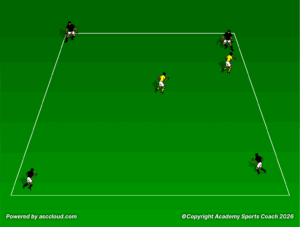
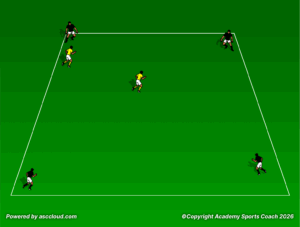
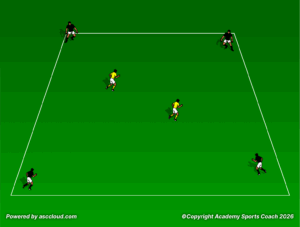
The next stage of the session is a simple 4 v 2 rondo with a defined box, I generally make it 10x10, but the number of players on the outside can be increased, and with it, the size of the grid. Players on the inside of the rondo are a pair, but the players on the outside should be paired off as well so they can quickly transition into the middle of the grid after the allotted time.
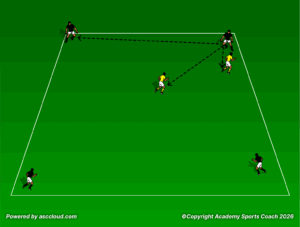
The drill starts with the players in the outside of the rondo looking to maintain possession with the players in the middle staying in the middle for an allotted time (generally 30 seconds). The players in the middle score by intercepting the ball or if the ball goes outside the circle. At the end of the allotted times, however many points the team in the middle won is the number of pushups/jumping jacks/etc the team on the outside will do. After, a new two man pairing enters the grid and repeats until each group has gone.
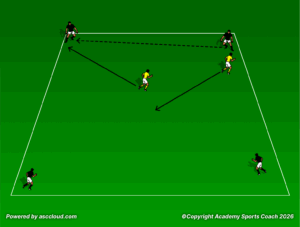
The key focus for this drill is the pressure/cover spatial relationship. First step is using communication to determine who is the pressure person, this may just be communicated by saying something like “ I got ball” or some other phrase to communicate that that player will be pressuring the ball, but establishing that verbiage for players so everyone is on the same page is key. Then, recognizing that they are covering the player in that position needs to put their body shape in a position that both blocks a forward pass or allows for a split while keeping their distance close enough that they can “jump” the pass to the player to the side the pressure player is “riding” the attacker towards. So if the pressure player has is right foot forward, he is giving the attacking player the room to move the ball to his right foot. Since the attacking player cannot go left because of the pressure player, and cannot go forward because of the cover player, he must go to his right, and once he passes the ball, we want the cover player to slide and attempt to challenge for the ball. The initial pressure player then drops into the cover position. The key coaching points we are looking to hit here are to keep pointing out the technical aspects of the press and discussing that we need to have patience in our press. The ultimate goal isn’t for our pressure player to win the ball, unless the opposition makes a mistake, but to make the opposition’s play predictable so that we can anticipate their movements and react to them. One point I like to make here is that since we are outnumbered we cannot go man to man, and the space provided means we cannot cover the entirety of the pitch since the rondo can stretch our defense. They will see this when the cover player leaves too early or leaves the split pass open and the players are “put in a washing machine” where they are just running back and forth attempting to stop the ball and establish a press. As a defensive pairing we want the players to “make the field small” and cut the options of the opposition to smaller areas with fewer supports.