Diamond Midfield Session
Part 1: Activation- 4v4
By: Justin Faust
This session will introduce the concept of the Midfield Diamond and how it helps teams keep possession, create passing options, and control the tempo of the game. I have used this for my team at the high school level, but it can also be used for teams still playing 9v9. The Midfield Diamond is built around movement, communication, and support, allowing players to always have multiple passing angles available. The Diamond allows midfield superiority, while also allowing flexibility in your team.
Throughout the training session, players will learn how to position themselves to create space, support teammates on and off the ball, and transition quickly between attack and defense. By working together as a connected midfield unit, we can improve our ability to maintain possession, break pressure, and build attacking opportunities effectively.
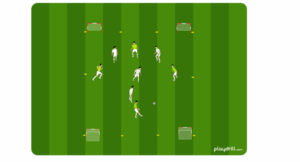
I tend to follow a Play-Practice-Play Model for this session, as it allows for players to get as many game-like scenarios as possible. As shown in Figure 1, when players arrive they will be put into a simple 4v4 game, with one team shaped in a diamond, and the other in a 2-1-1 Formation. This will allow for both the each team to be introduced to the principles in and out of possession for a midfield diamond.
Figure 1.
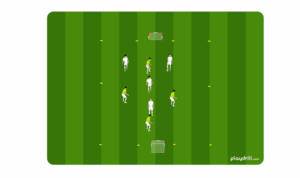
The midfield diamond requires effective communication for the pressing system to work correctly. One of the coaching points I make got the midfield is to always cut the field into thirds. This becomes imperative whenever there is a switch of play, requiring the defense to shift, as shown in Figure 2. There are many times that this “diamond” will transform into some version of a box. The focus should be more on the principles than the formation.
Figure 2
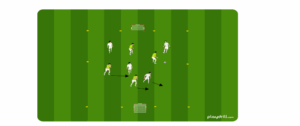
In possession the 2 sides of the diamond are absolutely key in their flexibility as players. They should be tested in their fitness and their competence. They will be the ones that are spreading out the defense, while also giving the top of their diamond the needed support to unleash attacking transitions. One of the coaching points that should be made in possession is the connection of these 3 players supporting the top of the diamond. Figure 3 shows how this concept can be mapped out on this small sided field during the activation stage of this session.
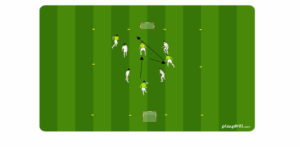
Sometimes an activation is going well and the coach can really build off the coaching points to introduce the Diamond Midfield. When this happens I like to add the progression of multiple goals as shown in Figure 4. This will spread the field in and out of possession to force the diamond to adapt to these situations. This will require the four players set up in a diamond to not only effectively communicate, but to also maintain a high work rate to cover the ground needed defensively!