
Attacking In Transition Form Your Own Half: Part 3- Cinco
By: Matt Carroll
This session is the third session that I have designed for my high school-aged teams for our open summer session here in New Jersey. This is a period where you can hold open sessions, clinics, tournaments, and leagues. The catch is none of this can be required, and cannot be utilized to “evaluate’ players in the regular season. That being said, the difficulty of planning these sessions is that you really won’t know numbers until maybe the week of, since players may be on vacation, a tournament, etc. That being said, we try to make these sessions something we can work on, no matter the numbers, and design them in a way that any level of player can get something out of it.
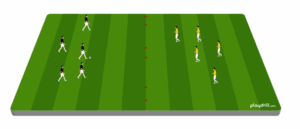
I have talked about this drill a lot, and it was even my drill when I discussed it on the podcast, but I really think it provides a lot of value to the players and keeps things simple. Normally, we have a 40x40 grid split width-wise, and 5 players on a team, one team per grid. The team on the ball possesses the ball in their grid, and the other team sends over three players to attempt to win the ball. If they do so, they then pass back over to their side and transition themselves, with three players from the other team coming over with them to transition the 5v3 to the other side. The idea is that normally we are working on our defensive shape to make the large field small and win, and transition from there. For this session, I want to isolate the transition moment and make it more frequent, so I'm shrinking the grid 25x25 and setting up three gates, using coaching sticks, in the middle of the field. The tight spaces mean we should have a higher rate of transition, but the sticks I will use to represent the places we want to get the ball when we transition to attack. When a defender wins the ball, they must pass the ball through one of the gates to their waiting teammate, or the transition doesn’t count, and the ball goes back to the team initially in possession.
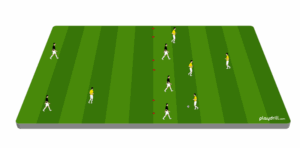
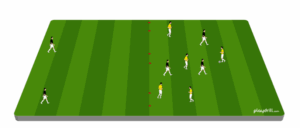
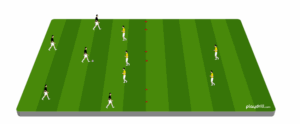
The point system will be 1 point awarded for 10 passes by the possessing team, 1 point for passing through the wide gates, and 3 points for the central gate, simulating a line-breaking pass to the forward. You can modify the points and the positions, or number, of the gates to suit your team's needs and plans for these moments. For example, if you want your team to switch the field rapidly when they win the ball, make the gate opposite of the side the ball is won on worth 2 points rather than 1. Ultimately, here we are moving past the initial things we want to do in these moments, getting the ball forward, creating width, providing depth, etc., and now focusing on the large-scale tactical elements of transition moments. In our next drill, we will move to a larger scale and implement these attacks towards the goal.

