
Attacking In Transition Form Your Own Half: Part 2- Bayern 12 Goal Drill
By: Matt Carroll
This session is the third session that I have designed for my high school-aged teams for our open summer session here in New Jersey. This is a period where you can hold open sessions, clinics, tournaments, and leagues. The catch is none of this can be required, and cannot be utilized to “evaluate’ players in the regular season. That being said, the difficulty of planning these sessions is that you really won’t know numbers until maybe the week of, since players may be on vacation, a tournament, etc. That being said, we try to make these sessions something we can work on, no matter the numbers, and design them in a way that any level of player can get something out of it.
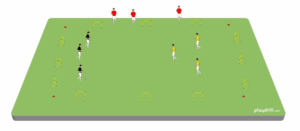
This drill comes from the Bayern Training Academy and works in a way that the players are going to see a ton of transition moments in the attack, with the opposition set up in varying positions every time. While I think this one is more focused on the transition from offense to defense, it can be used for both, and I think the energy it is going to provide to the session it is going to keep the players engaged to the coaching points.
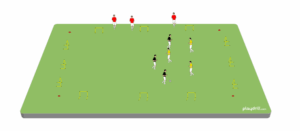
The drill starts with a 30x30 grid with three small-sized pug goals on each edge. We have two four-man teams squaring off against each other, attacking each other width-wise. On one side, depth-wise, is another team off the ball.
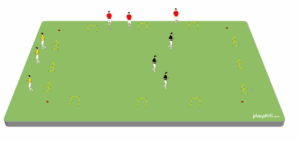
When one of the teams scores, the team that was scored on leaves the pitch to one side, width-wise, and the waiting team depth-wise enters the pitch with a ball and begins to attack the goals on the opposite side. The team that just scored must then work to defend the team entering play. This then repeated each time with the team getting scored on being replaced, and the team that scores staying on.
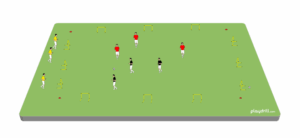
Again, I can envision this more so for the transition from attack to defense; the team waiting off to the side needs to quickly read the positioning of the team that has just scored. Where are they in relation to each other? Are they bunched up from the attacking funneling towards one goal? Is there a side of the field we can use to attack with a numerical advantage? The fact that the players are coming from a stop to attack also allows them to analyze these things without the pressure of having to be in defense prior, so we are isolating that idea of attacking the vulnerable spaces in transition, and then in our next drill, adding the defensive work to make the game decision more realistic.

