
Counterattacking Phase 2- Rondo Attack
By: Matt Carroll
This session is the next in my summer session planning period. For my high school team, we will be working on sessions that will introduce key topics for the season to both cement them for our players and to experiment with different drills and coaching points to fine-tune our approach once the season arrives. In this session, we are working on counterattacking via the “light bulb” moments we call our transition periods. In these periods, a core tenet of our philosophy is that changing the light switch from offense to defense, and vice versa, faster than our opponents gives us the distinct advantage over our opponents.
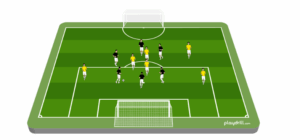
The Rondo Attack starts with a rondo group centered between the 18 and the halfway line with a six man rondo with three defensive players in the center. Outside of the rondo circle, three players from the defensive team are placed outside of the rondo and are not active in the initial rondo. At the 18 and at half, goals are placed, either small-sided goals or full-sized ones with keepers.
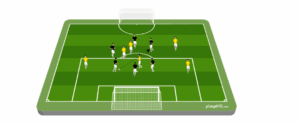
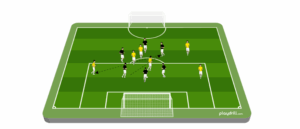
Play begins with the six-man rondo looking to maintain possession. To make this competitive, this team will score based on either the number of completed passes or time of possession; coaches can also create additional scoring opportunities for this team. The side inside the rondo attempts to win the ball, either via interception or the rondo squad playing an errant pass outside of the circle. If the team in the middle wins the ball, they can then go to either goal, and the players outside are activated and available as passing options, making the game a 6v6. This team then scores by scoring on either of the goals. Note: to avoid cherry-picking, have the last man in either rondo be considered the offside line, or play with a denoted line so that the players floating around the active Rondo cannot simply receive a pass standing next to the goal and score. If the initial rondo team wins the ball, you can choose to end the drill and revert back to the initial rondo, switch roles for the teams, or allow the team to reestablish their rondo in the center of the grid.
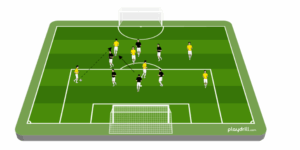
In this drill, we’re expanding the “light switch” cues by making them more game-like. In our first drill, the cue is pre-determined for the “light switch moment” by both the attacker and defender, but the decisions based on that cue then change. Now we are making the cues more random since it goes from shoot then move in the Chase Drill to reacting to a change of possession or leaving the rondo circle, and adding the decision-making of which goal to attack. The rondo itself makes for a more organic transition and forces the initial defending team to utilize their defensive principles to force the rondo to make a mistake, triggering the counterattack. Allowing the initial rondo group to reestablish their rondo also creates another counterattacking moment where a team looks to break quickly to space.

