
Counterattacking Phase 4- 5v5+4
By: Matt Carroll
This session is the next in my summer session planning period. For my high school team, we will be working on sessions that will introduce key topics for the season to both cement them for our players and to experiment with different drills and coaching points to fine-tune our approach once the season arrives. In this session, we are working on counterattacking via the “light bulb” moments we call our transition periods. In these periods, a core tenet of our philosophy is that changing the light switch from offense to defense, and vice versa, faster than our opponents gives us the distinct advantage over our opponents.
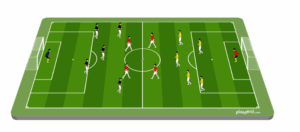
In the final stage of our session, we will move to a 5v5+4. To set up the field, we will move the goals into the 18-yard lines and put two 5-man teams on either side of half and then two neutral players on both sides of the pitch. The Neutrals are always on the attacking squad, but can never leave their half of the pitch. They can score, but they cannot be the first person on their half to touch the ball, essentially making them hold up players if they receive a pass or a forward who needs to control play until the rest of the team can catch up with them.. Players on the empty side can still be utilized in play as outlet players, generally setting up near the halfway line.
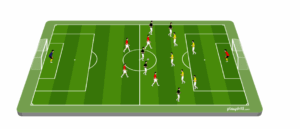
We start with an attacking team entering one side of play and attempting to score in a 7v5 with 2 outlet neutrals to help them out. If they score or the ball goes out the end line the defensive side then becomes the attacking team and can either build through their side with the 7v5 advantage or play directly to the two other neutrals and then use their entrance runs to simulate counterattacking runs by finding space where the defending team cannot cover as they retreat to their defensive side. You can play offside here both by the ball and by setting up a “breakout line” to make sure the neutral player receiving cannot pass, simulating the defensive line holding up the striker and forcing them to hold up play.
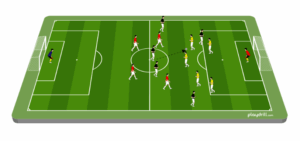
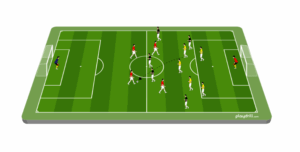
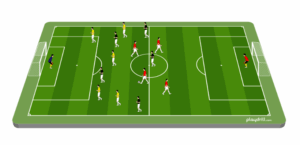
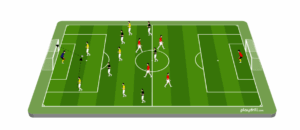
What we are looking for is to slow down the amount of transitions, but make them more organic and game-like. Coaching the neutrals, you will have an abundance of changes in roles; the changing of numerical advantages affects all players, and both squads will have plenty of room to find runs that force the opposition to run towards their own goal. The difficulty comes from having players forced to defend at a numerical disadvantage and create the counter out of this situation.
Ultimately, I think this session is flexible for however you want to shape your counterattacks; it doesn’t force any singular style and allows for an abundance of customization that can fit your team’s system and style!

