Defending Overloads in the Final Third
Part 3: Winger Entry
By: Matt Carroll
This session is the third in my team’s summer session folder. In New Jersey, we have an open period where any team can hold sessions. With multisport athletes, summer tournaments, and our participation in a summer league, we try to keep it to one session a week. We have to plan to not have all of our squad, and a fairly mixed group of freshmen, JV, and varsity-level players. Taking this into account, we tend to try things out and introduce topics that, once the season starts, we can revisit and refine. This session, we are working on overloads, but specifically in the final third, so players are really focused on creating the lowest percentage shot possible, covering their angles, and making sure to delay the attack long enough for players to get back and help on defense.
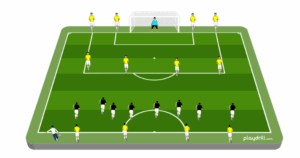
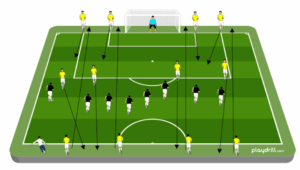
For the final drill of the session before I take off all of the stipulations and do 20-30 minutes of a scrimmage, here we are going to move to Winger entry. Again, we’re building on the technical and tactical concepts introduced from the first drill of the session and adding deeper focuses, specifically delay and back pressing, where the defenders in broken lines need to work back to their defensive positions.
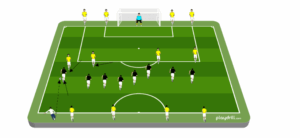
This drill is still half field with three breakout goals at half and a goalie defending the large goal, but now we have 4 defenders in working for the defensive side and 8 at the attacking side. In addition, we have 4 defenders sitting behind the big goal, and 4 more defenders sitting at the halfway line. To start the drill, a coach on either end of the sideline plays an entry ball into the wide channel for the attacking team to run onto. As soon as the ball is played, the four defenders and eight attackers can move. Once the ball is touched, the defenders on the halfway line can now enter and attempt to backpress the attacking team. The drill ends when the ball leaves either through the halfway line or the end line, or a goal is scored. Out of bounds is played live since it's a way for the defenders to slow the game down and delay, allowing for the players in the back press to get to their positions. Once the attacking team runs back, and as they do so, a coach plays another ball. The line of defenders standing behind the goal now steps up as the four defenders. The group that was backpressing them then runs back behind the goal, and finally, the original defenders now must run to the halfway line, touch it, and then they become the group that is backpressing. Repeat as many times as necessary. Since both teams have the ability to score, you can implement any type of scoring system, and if you have more players than required, the attacking team can rotate, and you can add an additional line of defenders behind the goal.
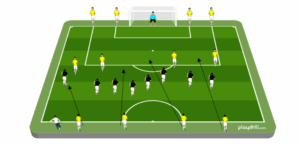
The important thing we are looking at here is how we deny forward movement from the attacking team, how do we force them sideways or negative? An 8v4 to goal on a full-sided half is going to be a difficult task so we need to be tight in our formation and disciplined in when we step in our pressure/cover/balance sequence. We also need the back pressers to not just run back, they need to get to a spot that aids the current defenders, creates numerical defensive advantages, and sets up opportunities to win the ball and counterattack. These should be the key focuses for you as a coach, and they should align with the style and systems you plan on running. From here, we move to a full sided scrimmage, and we look to highlight the moments where the session translates into our play!