
Session: Pressure Cover Balance Part 1
As always, making it to the United Soccer Coaches Convention was an enlightening experience. So many brilliant minds and concepts all pulled together at the same time, it's hard not to get excited to get back onto the field. In particular, I was inspired by the presentation by Coach Shap (who we had on the podcast in episode 408), where he discussed periodization and season long planning. The NJ High School season is still well away, but I am already trying to get some concept of what areas I want to focus on during our first weeks of the season. The session I am going to talk about here would likely be our fourth session of pre-season. The first two days being tryouts, then the 3rd, 4th, and sometimes 5th being days where the JV and Freshman squads are doing mirror sessions with the varsity. Conceptually, what I am trying to do is lay down basic tenets of our methodology to the players, as well as structuring the session to give my coaches a concept of the expectations and verbiage that we want to utilzie when talking about our core principles. Generally, what I want to do is hit major themes, scanning, pressure/cover/balance, and our shape in the middle third, and our key attacking concepts in the final third. This session will cover our defensive core concepts, focusing on basic 1v1 defending and building to the full pressure/cover/balance structure.
How do you structure your pre-season. Do you do something similar, do you make the focus specific game moments, do you break down sessions based on position? Let me know by reaching out to Matt@pennantcoaching.com.
What I find with my teams is that even players that are at a high level in terms of their club everyone benefits from refreshers in the core basics of defending, and for players that are not playing at a higher level club team, or playing club at all, the core technical concepts of defending are rarely visited so I use this session as an anchorpoint for all our discussions on defending throughout the season.
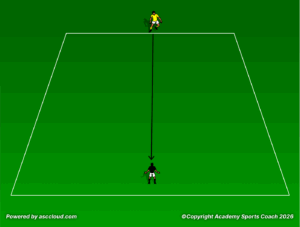
The first drill in this session starts with maybe 4 grids of 20x10 with players forming lines on either side of the shorter side of the grid. We start with the basics where I have one player from one side run up to the player on the other side and we work on just the concept of getting “touch tight” (I explain that normall this will be close enough to touch them with an outstretched hand plus one step back, and then explain that this distance will change based on the game situation) and where their feet are placed. We work on attcking a single shoulder of the opposition and having our feet staggered, and then having our front foot be placed outside of the body of the opposition player so that we are essentially giving them a lane to one side. We name the front foot the “poke” foot, since if the opposition goes to that side, we are going to “poke” the ball away, and the back foot the “ride” foot, since we are going to ride our opposition to one side.
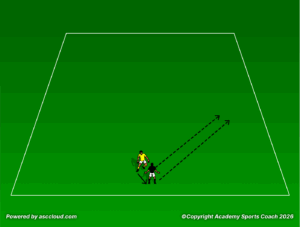
Another key coaching point is explaining to the defender that we aren’t necessarily working to win the ball as much as we are working to force the opposition into our cover. If they attack the poke foot, we are going to attack the ball and try to win, and then go on the attack. We will also discuss other cues for when to attack the bal,l such as a poor touch or when the defender takes a longer touch away from their body, and we can place our body between them and the ball. Players are made aware siatuations aren’t going to be as stagnant as this singular drill, but we are using it to demo to them what options they do have. After the defender goes and their footwork or body position has been adjusted, then they go to the end of the attacking line, and the attacking player runs across the grid to the defending side, and the next pair goes.
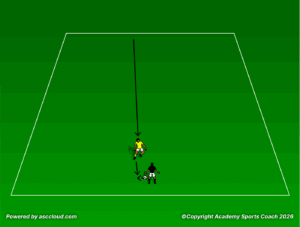
We then scale the drill up after maybe 2-3 reps from each player, keeping things mostly under 3-5 minutes, to work on the poke. We do this by giving the attacking player a ball and having the defender run up and break down their feet by getting touch tight. From there, we simulate the attacker turning into the “poke” foot and instruct the player to drive from their back foot, lock the front foot ankle, and drive through the ball in a way that propels them and the ball forward, putting themselves in between the ball and the attacking player. Same as before, the defender goes to the end of the attacking line, and the attacker goes to the end of the defender line, and the process is repeated, giving each athlete 3-5 reps.
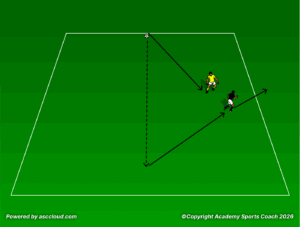
From there, we go full live 1v1s with the defender passing to the attacker. At this point, we see players tend to stop their feet and plant their heels when getting into a defending position so we are now taking the technical aspect of distance and footwork, but making it live so were talking about keepin their feet “out of the cement” meaning they are bouncy, on the balls of their feet, and moving with the attacker. As the attacker advances, they don’t stand still, and they don’t lunge for the ball; they use their body shape to drive the attacker towards the out-of-bounds line. Players defending score points in this portion if they can successfully drive their opponent out of bounds, or win the ball when their front foot is attacked. We then try to paint the picture that the out-of-bounds would be a help side “cover” defender who would then use that as a cue to step to the opponent, which would lead to part 2 of this article, our cover Rondo.

