World Cup Trends: The Pentagon
Many teams in the World Cup have discarded the staticness of traditional formations when building from the back. Out of possession, teams present a standard back-four, but the second they win the ball, they immediately morph into a 3-2-5 or a 4-2-2-2 structure. A few examples stuck out to me in particular.
-
- “The Asymmetric Fullback”: One fullback behaves strictly as a third center-back, while the opposite fullback bombs forward to act as a true winger. Under Mauricio Pochettino, the United States has used this perfectly, keeping right-back Alex Freeman deep to form a back-three, while allowing left-back Antonee Robinson maximum license to fly up the pitch. This has also allowed Sergino Dest to play in a much more natural winger role. In the past when he and Robinson flew up the field in a back 4- the two CB’s were left out on an island.
- The Dual No. 10s: Thomas Tuchel's England, has utilized a 4-2-2-2 setup that morphs in possession, pushing Jude Bellingham and Harry Kane into dual No. 10 roles to exploit the gaps behind opposition mid-blocks. This has allowed more freedom for them to roam and also find pockets in the offensive third, they normally would not be able to utilize.
- The Inverted Fullback: Roberto Martinez’s Portugal uses João Cancelo as an inverted fullback. He steps up and inward into the central midfield alongside a deep-lying playmaker like Vitinha or João Neves. The allows Bernardo Silva to essentially roam as needed in the attacking third, and specifically Ronaldo does not have to worry about his positioning and can attack the box, as was seen against Uzbekistan.
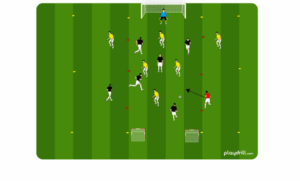
In this session I am going to look at ways that a coach can bring this concept into their drills to maximize midfield superiority through each of the above strategies. In Figure 1 I have put together a basic 3 team passing warmup. Because these three teams are sharing the same pentagon grid, the central space is highly congested. Players must constantly "pass and move" to their same color—delivering a pass and immediately shifting into an open pocket of space or through one of the internal cone gates. This is the same type of movement that is required to increase fluidity throughout the game. There are variations you can add to it such as:
- Pass and move into another grid
- Have to pass to a DIFFERENT COLOR upon receiving instead of the same color.
Figure 1
The Asymmetric Fullback”
The "Pochettino Pentagon”- one fullback behaves strictly as a third center-back, while the opposite fullback bombs forward to act as a true winger. Under Mauricio Pochettino, the United States has used this perfectly, keeping right-back Alex Freeman deep to form a back-three, while allowing left-back Antonee Robinson maximum license to fly up the pitch. This has also allowed Sergino Dest to play in a much more natural winger role. In the past when he and Robinson flew up the field in a back 4- the two CB’s were left out on an island.
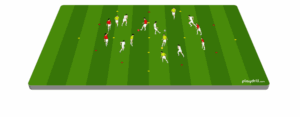
Figure 2 will highlight a transition game that can be used to work on the utilization of the Asymmetric Fullback to increase midfield superiority. The field will have 5 Players in possession (black) vs two defenders (yellow). Black will look to complete 4 passes and then send one of their fullbacks to dribble through the gate to join the next group with two new defenders joining that group. If they do so they will receive a point. Yellow will receive a point if they are able to win the ball and score in the mini goal. This will simulate the team in possession releasing one of their fullbacks to fly forward while the other has to move centrally. To make it more game-like you can designate that if a particular fullback dribbles through the gate it is 2 points.
Figure 2
The Dual 10’s
“Tuchel’s Tens”: utilizing a 4-2-2-2 setup that morphs in possession, pushing Jude Bellingham and Harry Kane into dual No. 10 roles to exploit the gaps behind opposition mid-blocks. This has allowed more freedom for them to roam and also find pockets in the offensive third, they normally would not be able to utilize.
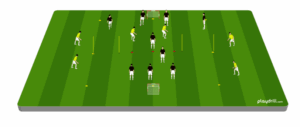
Figure 3 will showcase a 8v6 (+2) SSG where the attacking unit consists of 2 CMs, 2 Dual-10s, and 2 Wingers. They face a defensive unit composed of a flat back 4 and 2 central midfielders. The attacking team earns 3 points for any goal scored where the final assist or key defense-splitting pass originates from a dual-10 operating out of the central corridor. The defensive team will look play with 2 target neutrals they can hit to score in the mini goals. As you can see the dual 10’s will lead to an attacking superiority in the middle and some tough situations for the CBs to defend in. The attacking team is simulating a 4-2-2-2 setup. When one of the 2 stringers act as a 9, this will lead to a pentagon and an outnumbering in the attacking 3rd of the pitch.
Figure 3
“The Inverted Fullback”
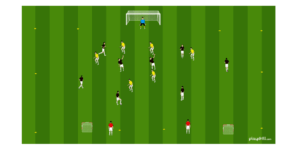
Roberto Martinez’s Portugal uses João Cancelo as an inverted fullback. He steps up and inward into the central midfield alongside a deep-lying playmaker like Vitinha or João Neves. The allows Bernardo Silva to essentially roam as needed in the attacking third, and specifically Ronaldo does not have to worry about his positioning and can attack the box, as was seen against Uzbekistan. Figure 4 will simulate a 6v7 small sided game with the RB able to enter the central area to create an overload, while defensively being required to move to their own grid. The field will have 3 vertical grids with players not allowed to leave their zone, outside of the RB (who will be RED).
Figure 4