Make your 1v1 Drills More Game-Specific
In modern soccer, the ability to win 1v1 situations is one of the most important skills a player can develop. However, many traditional 1v1 drills fail to truly prepare players for the demands of the
game because they isolate movements and decisions without recreating the pressure, speed, and unpredictability found in match situations. Players rarely perform skills in a vacuum during a game; instead, they must recognize space, react to defenders, transition quickly, and make decisions under pressure. Because of this, coaches must design 1v1 activities that are more gamelike and representative of real match scenarios.
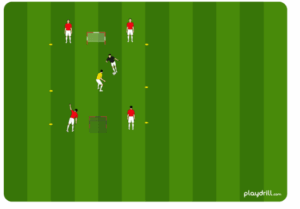
By incorporating direction, transitions, decision-making, and realistic defensive pressure into training, players can better transfer their technical ability into actual game performance. Gamelike 1v1 drills not only improve individual skill, but also develop the tactical awareness, confidence, and competitiveness needed to succeed on the field. Figure 1 is the typical 1v1 drill that you will see at youth practices, where the defender passes the ball out to start a 1v1 to a small sided goal. Coaches need to ask themselves if that situation presents itself enough in a game to warrant spending repetitions on it.
Figure 1
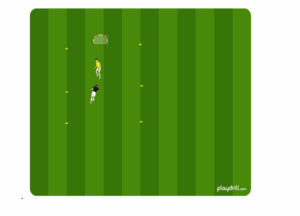
I tend to like to make 1v1’s replicate situations that both the defender and attacker will see during a game. The first situation in Figure 2 will have the attacking player have to check and receive a ball with a defender on their back. Upon receiving the ball they must score on one of the goals of the channel that they enter. This will allow the defender to have a recovery if they are beat, but also force the attacker to continue a dynamic dribble forward.
Figure 2.
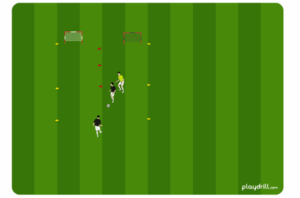
A situation I have found my team struggle with, even at the older ages, is to be able to be dynamic off of a throw in. We are even at the point where we are having professional teams employ a throw-in coach because this is such a big part of the game. Figure 3 has a similar setup as Figure 2, but now the play will start with a throw into the attackers feet and it will be the job of the defender to have to recover to defend them. The attacking player should look to beat the defender on either their first or second touch.
Figure 3.
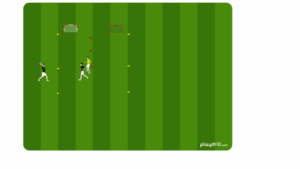
I like to transition to an even more competitive scenario of 1v1 (+2) in Figure 4. The only restriction I add to this game is that the attacking player must play the ball to the outside neutral before they may score. This will require the attacking player to move off the ball and to attack as soon as they receive it. Both of these movements are more game-like than simply dribbling at a defender and shooting.
Figure 4.
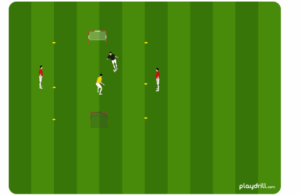
Figure 5. Is a progression of this game and set up as a a 1v1 (+2) with each attacker having two target players they must play before they can score. This replicates movements in the box to score on an opponent. If you want add even more incentive you can allow the attacker to receive two points if they complete a 1 touch finish off of their wall pass.
Figure 5.