
Creating Overloads at Midfield: Part 1 Strength and Conditioning
This session is the second session that I have designed for my high school aged teams for our open summer session here in New Jersey. This is a period where you can hold open sessions, clinics, tournaments, and leagues. The catch is none of this can be required, and cannot be utilized to “evaluate’ players in the regular season. That being said, the difficulty of planning these sessions is that you really won’t know numbers until maybe the week of, since players may be on vacation, a tournament, etc. That being said, we try to make these sessions something we can work on, no matter the numbers, and design them in a way that any level of player can get something out of it.

For the first part of the session, we are doing our FIFA 11+ workout. There is plenty of scientific evidence that this particular warm up reduces injuries dramatically, so I highly recommend you Google it, and there will be a blue sheet that has a breakdown of how to do every exercise. There is an optional third stage of the FIFA 11+ that you do not have to do every day, which tackles strength training, so on this day, we will include that. One thing I add to the FIFA 11+ occasionally is a speed circuit that we tack onto the second phase of FIFA 11+, where we keep the cones the same and have players first run to the cones and make a small choppy circle around each cone with their feet. When they completely circle the cone the then break and sprint to the next cone and repeat. We are working on quick feet here with control, and then that initial step of acceleration coupled with deceleration. From there, we have them hop over each cone, then jump backwards over the cone and land in a way where their body is leaning forward, and they drive in a sprint to the next cone before again decelerating and repeating. From there, they do the same but sideways. After that, we have them do a long broad jump, jump backwards and then sprint the length of the cones. Then they bound on one foot side to side in an “ice skater” pose and perform another long sprint. After that, they stand feet shoulder length apart and begin to tip their head forward until they begin to fall. Whichever foot catches them, they then use that to drive forward into a sprint. This whole portion, we are really focusing on the first step and the appropriate running form. After that, they go into two slow jogs around the cones, where we discuss meditation and breathing techniques to help them control their breathing and heart rate.
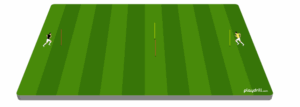
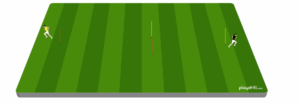
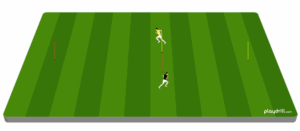
For this session, we want to make sure we are preparing their bodies for the season ahead and the dynamic motions the games are going to require. For our first drill here, we are going to have two coaching sticks about 30 feet apart, with two other coaching sticks in the middle between them forming a gate. One line will be at one end, the other line at the other. On a whistle, the players run at and around the stick to the right of them and then to the stick on the opposite end from where they started. Once they reach there, they then drop their right hip backwards, swinging their hips around in a drop step and round the stick. After this, the first one to then sprint and touch the middle stick on their side wins the race.

Next, we have Pool Noodle Tug of War. Here we have a cut up pool noodle, maybe ¼ th size of the full noodle, and each player places a hand on one end of the noodle and stands on one foot. The players then try to pull the noodle away from the opposing player without themselves falling, so we’re working on balance and control here with a single leg stabilization.
After that, we play tag. At first, the players often seem confused, but this is probably the phase of practice where they are working the hardest, just from the pure fun of the game. We box off an assigned area and have a tagger, and just let the game rip. From here, we may make it so there are multiple taggers, make it a knockout tag, use the pool noodles as a tagging device, turn it into freeze tag or stuck in the mud tag. Either way, the focus is going to be on constant, dynamic motion, where players are looking to evade
At this point, we may add in Rugby Tag depending on the conditions of the players. Here we set up a grid of cones 3x3 and have two players in bear crawl position on either end of the grid. They must stay in bear crawl position and cannot go through the grid. One player is designated the attacker, and the other is the prey, and the attacker must then try to tag the prey player. We try to limit these to 30s or less since it is high intensity. After that two new players get into position and the process repeats.
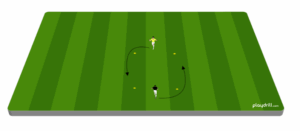
You are definitely going to want to factor in fitness levels, heat index, and hydration for this session, but the key at the end of the day is to get players to move in dynamic motions that are not completely linear. We want them to make unpredictable jukes and feints, using both their upper and lower body, and making decisions based on the visual stimuli they are receiving from games like tag. After this, we would give a long hydration cool down and move onto our on-the-ball workouts, starting with a 2v2v2 Rondo in Part 2.

