
Counterattacking Phase 1- Chase Drill
By: Matt Carroll
This session is the next in my summer session planning period. For my high school team, we will be working on sessions that will introduce key topics for the season to both cement them for our players and to experiment with different drills and coaching points to fine-tune our approach once the season arrives. In this session, we are working on counterattacking via the “light bulb” moments we call our transition periods. In these periods, a core tenet of our philosophy is that changing the light switch from offense to defense, and vice versa, faster than our opponents gives us the distinct advantage over our opponents.
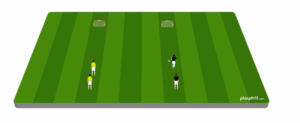
In our first drill, we are working on the concept of timing in our counterattack. We want to drive forward and get the defense to be facing their own goal in pursuit. In doing so, our players will be faced with options to drive with the dribble or play a forward or diagonal pass to attack the gaps left in the defense as they transition from an attacking footing to a defensive one.
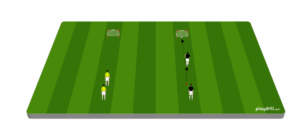
The chase drill is set up with two pug sized goals about 30 feet apart and lines facing each goal around 40 feet away. Halfway between each line and the goal is a coaching stick; players cannot shoot on goal until they pass this coaching stick. Each player in both lines has a ball. The drill starts when one player from one line begins dribbling towards a goal. Once they pass the halfway stick, they can shoot. As soon as that player shoots, a player from the opposite line can then begin to dribble towards their goal. The player who initially shot then must work to cut at an angle to defend the second player and force a contested shot on the pug goal. Once the second player shoots, or is intercepted, a player from the original line that went then goes towards the goal, and the process repeats until there are no more balls.
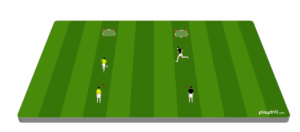
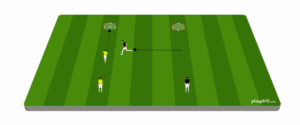
While the focus isn’t defensive, the defensive players can work on their defensive angles of pursuit, but for our attacking players we are working on them reading pressure. If players fail to attack the open space, the defender will be able to contest the shot or engage the attacker in a 1v1. Once the attacking player passes the stick, they then must decide to shoot early before the opposition can engage them, but settle for a lower percentage shot, or dribble closer, risking the defense catching them but gaining a higher percentage shot. In terms of the game, we are working on the timing and tempo of our counterattack

