
Having interviewed several different coaches for the Soccer Coaching Weekly Podcast (formerly WCC Podcast) I got to thinking. Everyone has all of these great ideas, how they run their sessions, how they view the game philosophically, how they approach each issue in their own unique way, so I decided that I would take a session I had and run it by some of truly wonderful coaches that I know and see what they had to say about it. Below is the session in question, followed by some insights from colleagues and former guests, feel free to reach out to Matt@pennantcoaching.com to add your own ideas!
First thing is first, the session. Inspired by some of the lectures and conversations at the United Soccer Coaches Convention I wanted to get a head start on my pre-season preparation for the 2026 season. In our interview with Coach Shap he discussed focusing your limited sessions from the High School perspective to the really core, key concepts you want to address, and hammering those home. For me, any session with scanning at any level is going to get your most bang for your buck in terms of returns so I started there. In terms of the point of the season I have this planned out to be my 3rd session into preseason. With my team that will be the day after we have settled in and cut any players who have not made the team and placed the rest into Freshman, Junior Varsity, or Varsity. At this point I have between 60-80 players on the field with four coaches spread over two fields. Generally speaking, I will have two coaches per field and both fields will mirror each activity. If possible I will try to make it to both fields to observe, coach, and discuss progress with my coaches. My technical points will be:
- Foot positioning on the half turn
- The ability to close out the turn and change direction under pressure
- When and where to look when scanning
- Visual and Verbal Cues
Drill 1: Scanning Rondo
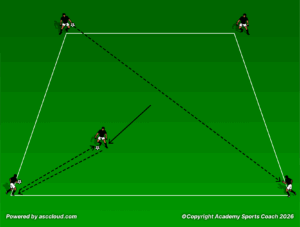
For my first drill I have an unopposed scanning Rondo I call “Two Ball- Check Your Shoulder”. I have four players on the outside of the Rondo, two of these players have a tennis ball (or something similar) in their hand. There is a player in the middle with a soccer ball at their feet. The drill starts when the middle player passes to one of the players who has a tennis ball, and then they outside plays that pass back 1 touch. While this is going on the player with the other tennis ball throws it to a different player that is on the outside and empty handed. Now when the player in the middle receives their pass back they are looking to find where the tennis ball is and take their turn in a way that guides them to that player and the process repeats. I would suggest only letting each turn go for 30s to 1m, and your focus here is teaching technique while the players are learning to check their shoulder and read the visual cues. I would likely be doing this drill before I even start my full warm up (we utilize the Fifa 11+ Warmup, with some additions to work on sprint technique). My focus here is teaching and “painting” the picture of what scanning is going to look like to the players. I would also say I am looking for the players to use the visual cue of holding the tennis ball, rather than using verbal cues so it forces the player to scan and make a decision based on these stimuli. From there, I would move on to my warmup. You could reverse the warm-up, though, and add a progression to this drill where you make it competitive and players need to track how many passes they complete in a certain amount of time to ramp up the competitiveness of the drill
Drill 2: 4v4+1
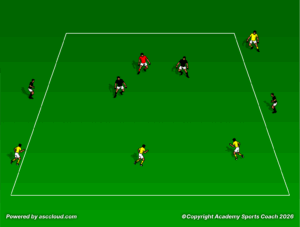
Here I am moving to more of my game-like active play, and try to continue to do so throughout the session. We are going to make about 20x20 grids for our players and have two teams of four with a neutral. Two of each team’s players will be inside the grid and the other two will be positioned outside the grid with the ability to move anywhere they want on the outside of the grid. A 9th player will play as the neutral inside the grid. Here we have each team trying to possess the ball with the 3v2 in the grid, but with the ability to have players on the outside work as bumpers to support them, and when these bumper players receive a pass they only have two touches and three seconds total to play a pass back into the grid, this keeps the tempo of the game and forces the players inside to move accordingly to these restraints. What we really want here is to create repetition in players receiving with their backs to their opponents and now utilizing the technical points of scanning we addressed in the first drill. There isn’t direction at this point so they are making these decisions based on the small picture area of their immediate grid, so we want to build to that in our next drill, making the decisions progressively more complicated. Some insight questions we can ask are : “What exactly are we looking for when we are scanning,” and during a stoppage asking “Based on the information in this freeze frame, what is the right touch here, where are we looking to move the ball?”.
Drill 3: 4v4 +4
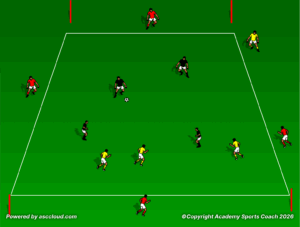
Now we are expanding the grid, to the length from 18 to half and the width from touch to the corner of the 18. In addition, we add a 5-yard endzone lengthwise to the grid and have a neutral in each endzone, as well as a neutral standing on each touchline. Inside the grid we have four players on each team and four bumper/endzone players. The teams inside the grid can score in this game by passing to each player in the end zones in sequence. No one can enter the endzone, and you can put perimeters for how long bumper players or endzone players can hold onto the ball, or allow them to play based on what the field is giving them. We are now directional so we are not simply focusing on our scanning to connect, we are now goal orientated and weighing our decisions on possession v. attack. Do I look to advance here? Do I want to hold on because we are numbers down and maybe go negative? Guiding your players to ask these questions of themselves is the key focus of this drill.
Drill 4: 4 Grid 1 Up
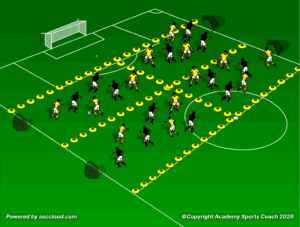
Now we are adding goals to our session in addition to the directional play. We are setting up the field to take up the halfway line to the 18, with four grids equally dividing the grid. On the touchline, in the middle of each grid we have a goal. Each grid has three players from each team, except for one grid which will have four. Players can move grids, but a team cannot have more than four players in each grid at a time. Each team can score on any of the goals and attempt to utilize the numerical advantage of the fourth player to create overloads. A team that dispossesses the opposition cannot score on the grid they are in though and must try to break out and score in the other three grids. By overloading the directional play and goal scoring opportunities, we are hoping that when the game gets more linear with one goal, that the session will be more difficult than the match. Here I really want to challenge my players with questions like “ Where is the space, where can we use overloads?” and “ Is it better to stay or go? Do we try to win in this grid that has become a 4v4 since the other team has moved their player to counter the overload, or do we restart our attack in another grid?”.
Drill 5: Now with my remaining time we will break up into four teams and scrimmage 11v11 and use this time to assess if the concepts we have pushed during the sessions and look for gaps in understanding to correct, or moments of success to highlight.
Next in Part 2 I will examine how other coaches viewed this session and what changes to the structure and form they would make!

