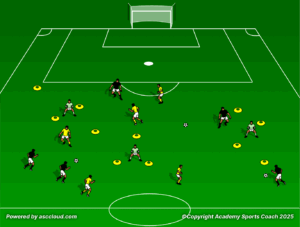
On Episode 5, Matt and Fedd met with Jake Aferiat, Boys Soccer Writer for NJ.com, to discuss the upcoming NJSIAA Boys Soccer Playoff picture and what it takes for teams to show up in the big games. In the episode, Coach Matt discussed the Goalkeeper Box Drill that he has been using to get his players match-ready for their first-round playoff game. The purpose of the drill is to create a chaotic atmosphere for players to be both overloaded with stimuli as well as choices. The multiple balls mean that players are constantly forced to think both offensively and defensively, while the large amounts of open space vs. the tightly contested areas have players deciding whether to attack where they are or find a better opportunity elsewhere.
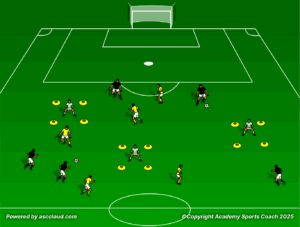
The drill starts with a field making up the top of the 18 to the halfway line. With three 10x10 boxes arranged around the grid. In each grid is a goalkeeper. There is two teams spread around the grid and two balls that are played in by the coach. Field players are not allowed to enter any of the boxes, and the goalkeepers cannot leave their boxes. Players score by connecting a pass that breaks two lines of the box and is retrieved on the other side by one of their teammates. If the pass is intercepted by the goalkeeper, they then punt the ball randomly somewhere else in the grid. At the end of the allotted time, the team that has completed the most passes through the box wins the game.
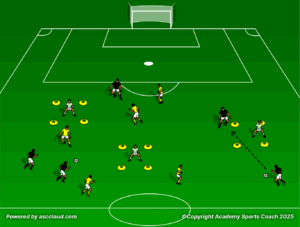
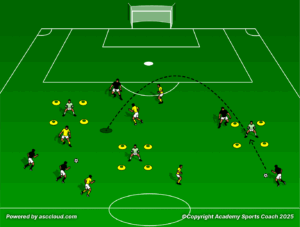
The coaching points for this drill is to find the numerical advantages on offense and get compact defensively. If there are few defenders around the box the attacking team can score multiple points in a short span, but if they try to force the ball through when they are numbers down they can easily turn the ball over. The defense, because the grids are so small, can effectively drop in front of the boxes and get compact, making it difficult for the opposition to find a way through. The size of the grid, the size of the box, and the shapes of the goalie boxes can all change to vary the difficulty of the drill.